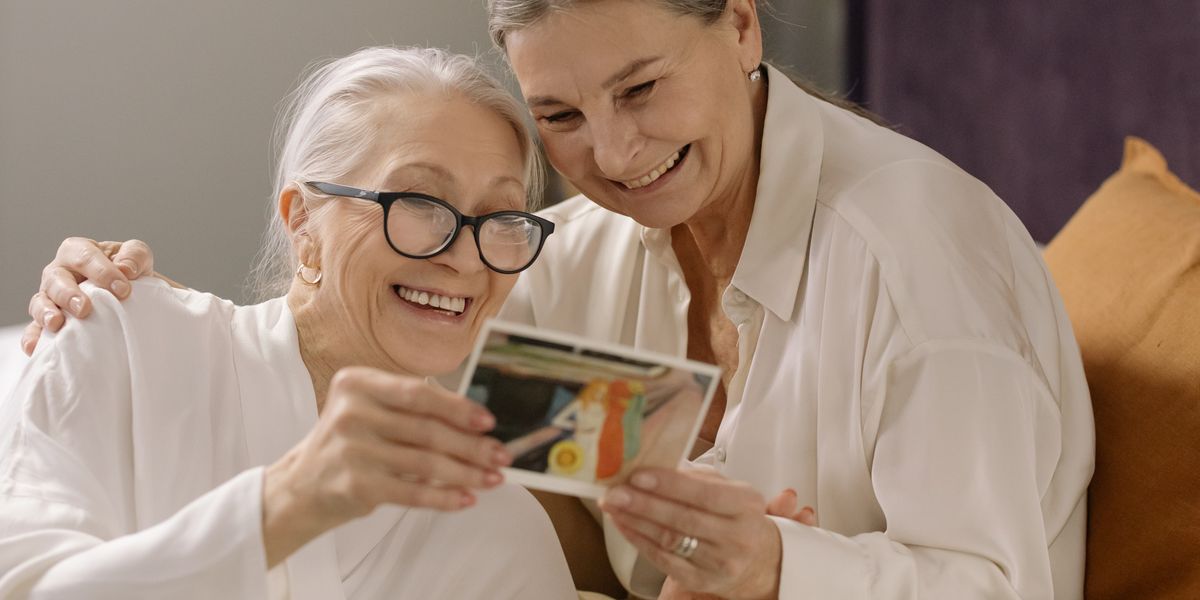
If you've taken an activity-professional course or sat through a surveyor's exit conference, you already know the vocabulary: person-centered care, life-story work, reminiscence, meaningful engagement. These aren't trends. They're the agreed-upon standard of good practice in senior living: written into federal requirements for nursing homes, echoed by state rules for assisted living, and taught in activity-professional credentialing. (New to the topic? Start with our complete guide to reminiscence therapy.)12
So why is the standard so unevenly met? Not because anyone disagrees with it. Because doing it well is enormously labor-intensive, and that labor is the first casualty of a short shift. A proper reminiscence program means knowing each resident's history, preparing prompts tailored to it, running sessions, capturing what comes out, and feeding it back into programming. One dedicated coordinator, ninety residents, a floor that needs covering — and the beautiful life-story binder gets started in January and abandoned by March. Every coordinator knows this story because they've lived it.
The field doesn't have a best-practice problem. It has a best-practice sustainability problem.
What the evidence actually says
It's worth being precise, because honesty is the whole brand here. The strongest synthesis of the research is the 2018 Cochrane systematic review of reminiscence therapy for people with dementia, which pooled many randomized trials. Its conclusion is modest and worth quoting accurately: effects were inconsistent and often small. Across all settings there was no important effect on quality of life, but in care homes there was probably a slight benefit; one-to-one reminiscence probably helped mood a little, and group reminiscence probably helped communication. The small cognitive gain was judged of doubtful clinical importance. How much it helps depends heavily on format, setting, and structure. For a fuller walk through the trials, see what the research actually shows.3
Read that carefully and you get a clear instruction, not a marketing slogan:
- Structure matters. Ad-hoc "remember the old days" chats are weaker than a consistent, well-designed sequence of prompts.
- Individual attention matters. One-to-one reminiscence — actually listening to this person's life — is powerful and historically the hardest to staff.
- Consistency matters. A program that runs every week beats a brilliant program that runs twice and stops.
Those three requirements — structured, individual, consistent — are exactly the three that human staffing makes hardest. Which is precisely where a well-built tool earns its place.
How Porchlight delivers the structured version
Porchlight is built around an interview engine, not a random question generator. Sessions follow curated interview tracks — early life, work and vocation, love and family, places and homes, beliefs and proudest moments — organized by life chapter and starting in childhood, the way structured life-review programs are, with the resident always in control of what to answer. It's the structure the evidence asks for, applied identically to every resident, every time.
The resident stays in control
Every question can be skipped with one tap, and nothing is ever graded or treated as a memory test. Questions a resident has already answered never come back. Family members can add questions and photos of their own, so a session can follow the people and places that matter to this resident. Staff remain the facilitators: they see what was shared and decide how to use it.
How it delivers the individual version, at scale
One-to-one reminiscence is the gold standard and the staffing nightmare: there simply aren't enough coordinator-hours to sit individually with every resident, every week, forever. Porchlight's resident app is a one-to-one session — patient, unhurried, undivided attention, no timer — that a resident can do with a tablet and a volunteer or family member nearby, freeing the coordinator to do the high-value human work of using what comes out. You get the individualized format the research favors without needing to clone your activities director.
And the consistency the binder never had
This is the quiet superpower. A paper life-story project depends on one person's willpower and dies the week they're out sick. Porchlight runs on a system. Sessions accumulate, profiles deepen, and the staff briefing and story highlights turn the raw material into usable material — recognition moments, bulletin-board stories, conversation starters — without anyone re-doing the work from scratch. Best practice stops being a heroic effort and becomes the default state of the building.
And because every session is captured and preserved, you build something the binder never could: a permanent life-story archive for every resident — which doubles as documentation that your person-centered care is real, current, and individualized when a surveyor or a family member asks.
What we won't claim
We won't tell you Porchlight is a therapy or a treatment — it isn't, and the Cochrane authors are appropriately cautious about the size of reminiscence effects. We won't invent a statistic about your outcomes. What we'll say is grounded and defensible: the field already knows what good looks like; the barrier has always been the labor of doing it consistently and individually; and that is exactly the barrier Porchlight removes. You bring the standard. We make it sustainable.
Make best practice your default
See the interview tracks, the one-button resident app, and how sessions become programming — in fifteen minutes.
Explore a live demo Book a demoSources & notes
- Centers for Medicare & Medicaid Services, Requirements for Long-Term Care Facilities (42 CFR Part 483), establishing person-centered care planning and individualized activities (42 CFR 483.24(c), surveyed as F679) as federal requirements for nursing homes. Assisted living is regulated by the states.
- National Certification Council for Activity Professionals (NCCAP) and allied activity-professional standards, which teach life-story and reminiscence work as core competencies.
- Woods B, O'Philbin L, Farrell EM, Spector AE, Orrell M. Reminiscence therapy for dementia. Cochrane Database of Systematic Reviews, 2018. CD001120.pub3. PMID 29493789. Effects are described by the authors as small and dependent on format and setting; reminiscence is not a clinical cure, and Porchlight is an enrichment tool, not a medical device.
No fabricated customers, testimonials, or outcome metrics appear in this article.